
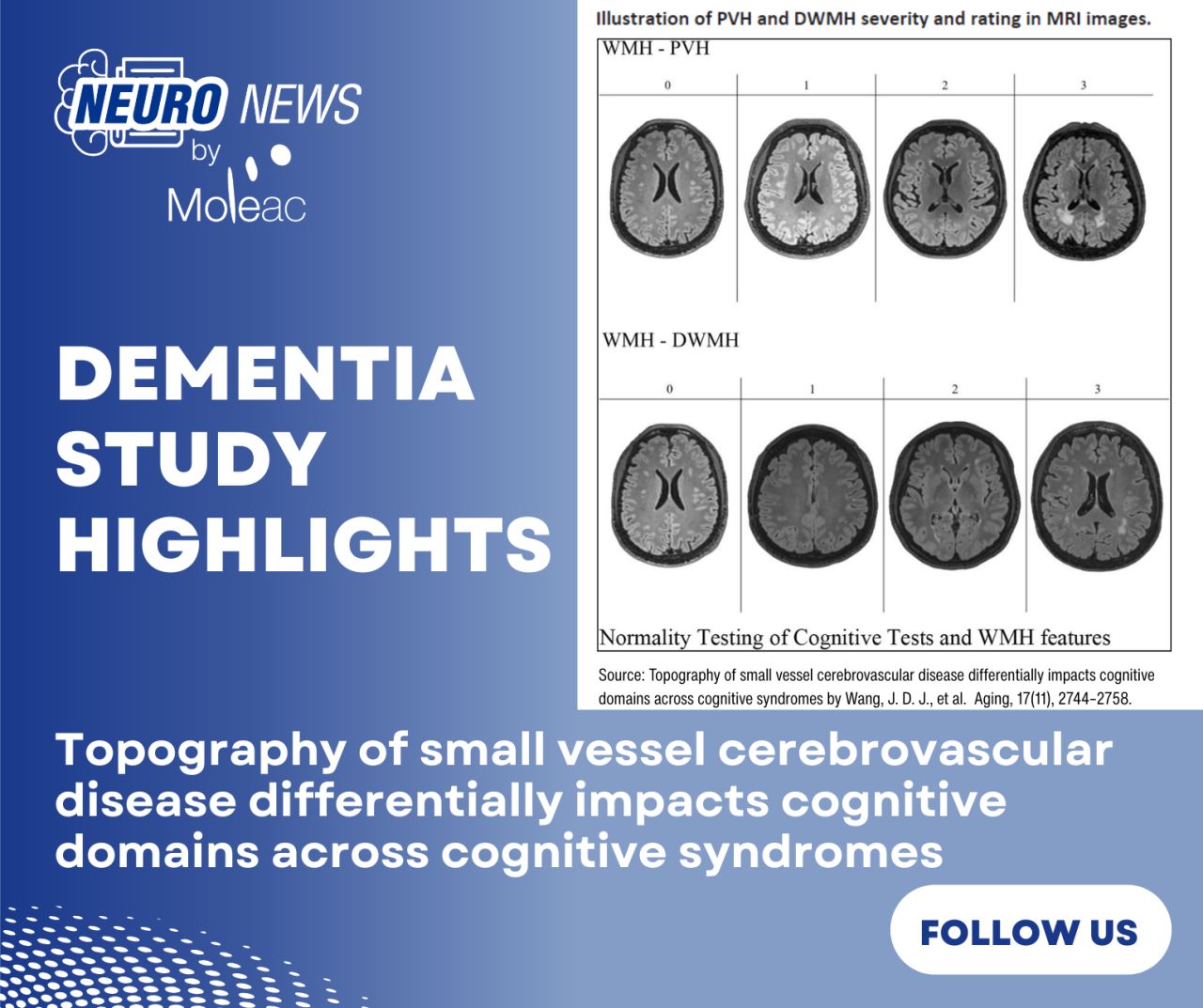
DEMENTIA STUDY HIGHLIGHTS – Topography of small vessel cerebrovascular disease differentially impacts cognitive domains across cognitive syndromes by Wang, J. D. J., et al.
This study demonstrates that white matter hyperintensity (WMH) burden differentially influences cognition depending on both WMH subtype and stage of cognitive decline. Specifically, deep white matter hyperintensity is closely linked with learning and memory impairment, whereas overall WMH burden (graded from 0 to 3 with the Fazekas scale) appears to more strongly affect attention in cognitively normal individuals and learning/memory in mild cognitive impairment.
This nuanced view of WMH subtypes underscores the importance of precise neuroimaging assessments in early-stage dementia care. Such targeted evaluations could enable more personalized interventions and more accurate prognoses for populations at high risk of vascular-related cognitive impairment.
Key takeaways:
• Doctors should carefully look at the type of WMH a patient has, not just their total amount.
• This can make early screening for dementia more accurate.
• More precise MRI assessments could help doctors tailor treatments or lifestyle advice to each patient.
Access the full article at: Wang, J. D. J., Leow, Y. J., Vipin, A., Sandhu, G. K., Dang, C., Saffari, S. E., & Kandiah, N. (2025). Topography of small vessel cerebrovascular disease differentially impacts cognitive domains across cognitive syndromes. Aging, 17(11), 2744–2758.
https://www.aging-us.com/lookup/doi/10.18632/aging.206336. This is an open-access article under a CC BY 4.0 license.