

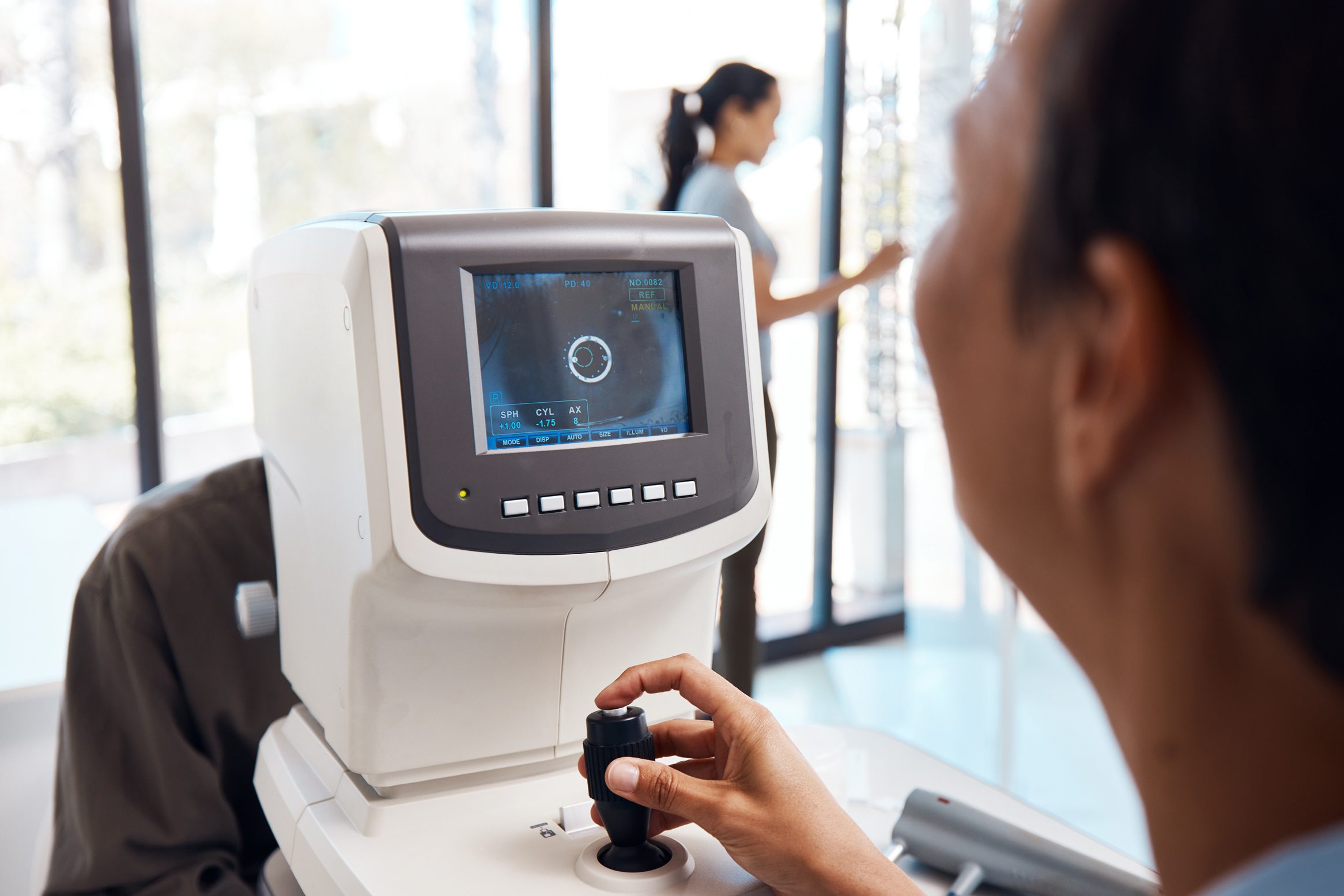

The visual field test is a fundamental examination for assessing a person’s visual field and detecting possible deficiencies, such as those that occur after a stroke. This test is crucial for diagnosing and treating visual problems that affect patients’ quality of life, as it can identify subtle alterations that might go unnoticed in a conventional eye examination.
What is the visual field test?

The visual field test is an ophthalmological examination that assesses the visual field, meaning the total area that can be perceived when the gaze is fixed on a point. This test measures the eye’s ability to detect light stimuli in different directions, helping to identify areas of vision loss known as scotomas.
There are two main types of visual field testing:
- Static perimetry:
- It presents lights of different intensities in various positions to determine visual sensitivity in each area.
- Kinetic perimetry:
- It uses moving stimuli to map the boundaries of the visual field.
Both modalities make it possible to detect and locate visual alterations caused by various conditions, such as brain damage related to a stroke.
Relationship between the visual field test and strokes
The brain processes a large part of visual information, particularly in the occipital lobe. When a stroke affects these areas or the visual pathways, it can cause partial or total vision loss in one or more parts of the visual field.
Some of the most common visual defects associated with strokes include:
- Homonymous hemianopia:
- Loss of vision in the same side of the visual field in both eyes.
- Quadrantanopia:
- Visual loss in one quarter of the visual field.
- Localized scotomas:
- Small and specific areas of visual loss.
The visual field test makes it possible to identify these alterations with precision, facilitating a complete diagnosis and guiding rehabilitation.
How is the visual field test performed?
The procedure is simple, non-invasive, and performed in an ophthalmology or neurology clinic:
- Patient preparation:
- The patient is asked to sit in front of a specialized device and fix their gaze on a central point.
- Presentation of stimuli:
- During the test, lights or stimuli appear at different points in the visual field, and the patient must indicate when they perceive them.
- Results:
- The collected data is processed to generate a visual map showing areas of normal perception and areas of visual loss.
The examination can last between 10 and 30 minutes, depending on its complexity.
Importance of the visual field test in strokes
The visual field test is crucial for:
- Early diagnosis:
- It detects visual alterations that may not be evident to the patient.
- Assessment of the severity of brain damage:
- It allows correlating visual losses with the areas of the brain affected by the stroke.
- Follow-up and rehabilitation:
- It helps monitor visual recovery and assess the effectiveness of therapies.
- Prevention of complications:
- It identifies visual problems that could increase the risk of falls or accidents.
Limitations of the visual field test
Although it is a valuable tool, the visual field test has some limitations:
- It cannot identify visual problems related to more complex perception disorders, such as visual agnosia or visual neglect.
- It depends on the patient’s active cooperation, which can make it difficult to perform in individuals with severe cognitive or motor impairments.
For this reason, it is often combined with other studies, such as magnetic resonance imaging or neuropsychological tests, for a comprehensive diagnosis.
Treatment and rehabilitation of visual deficits after a stroke

The detection of visual alterations through perimetry is the first step toward an appropriate treatment plan. Therapeutic strategies include:
- Visual rehabilitation:
- Specialized therapies to stimulate the residual visual field and improve adaptation to the losses.
- Environmental adaptation:
- Modifications at home and in the workplace to reduce risks and facilitate mobility.
- Assistive devices:
- Use of special lenses, prisms, or digital technologies to compensate for visual loss.
- Secondary prevention:
- Treatment of cardiovascular risk factors to prevent future strokes.
Impact of the visual field test on quality of life
El test de campimetría no solo identifica problemas visuales, sino que también orienta las intervenciones necesarias para mejorar la calidad de vida de los pacientes. Detectar y tratar alteraciones visuales tempranamente reduce el impacto de estas en actividades cotidianas como:
- Driving
- Reading
- Recognizing faces
- Avoiding obstacles while walking
Conclusion
The visual field test is an essential tool in the assessment of patients with strokes, as it allows for the detection and mapping of visual alterations that affect independence and functionality. Although it cannot directly resolve visual losses, it facilitates the planning of personalized rehabilitation strategies, helping patients adapt to their limitations and regain, as much as possible, a full and active life.
If you would like more information about NeuroAiD II, please fill out this contact form.
"*" indicates required fields


