


Neurological rehabilitation has evolved significantly in recent decades due to the development of models that allow clinicians to understand and measure patients’ functional recovery following brain injury. Among these models, the Brunnstrom Scale has become a fundamental tool for physiotherapists, neurologists, and occupational therapists. Developed by the Swedish neuroscientist Signe Brunnstrom, this scale enables the assessment of motor recovery in patients who have experienced a stroke or any form of hemiparesis.
What is the Brunnstrom Scale?
The Brunnstrom Scale is a neurological assessment model that describes the typical sequence of motor recovery following a stroke. This scale is based on the observation of synergistic movement patterns and the progressive return of voluntary motor control. It is divided into seven stages, ranging from the complete absence of voluntary movement to full or near-full recovery of motor function.
The value of the Brunnstrom Scale lies in its ability to provide a structured framework that helps clinicians identify the patient’s current stage of recovery, establish realistic treatment goals, and monitor progress over time. Additionally, it supports the planning of individualized interventions tailored to the patient’s functional status.
The Seven Stages of the Brunnstrom Scale
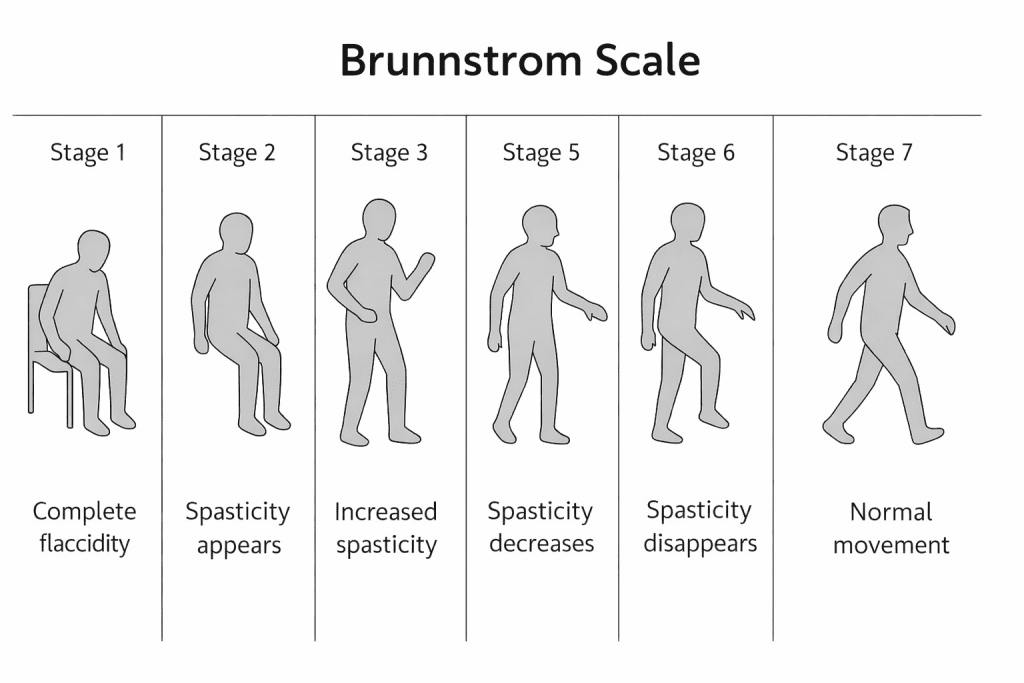
The Brunnstrom Scale consists of the following stages:
-
Stage 1: Complete Flaccidity
In this initial phase, there is no voluntary muscle activity. The patient presents with complete flaccidity and absence of reflexes. This stage may last from hours to days, depending on the extent of the brain injury. -
Stage 2: Emergence of Spastic Synergies
Reflex movements or involuntary synergies begin to emerge. These movement patterns are typically spastic and are not under the patient’s voluntary control. -
Stage 3: Voluntary Synergies
The patient is able to initiate movements within specific synergistic patterns. Although movements remain limited and rigid, they represent a significant step forward in the recovery process. -
Stage 4: Decline of Synergies
The patient begins to break away from synergistic patterns and is able to perform some isolated and controlled movements outside of the synergy. -
Stage 5: More Complex Movements
The range of voluntary movements expands and coordination improves. The patient is able to perform more complex movements, although some difficulties may still be present. -
Stage 6: Normal Coordination with Some Limitations
Movements are nearly normal in terms of coordination and speed. Minor deficits may persist, but overall functional capacity is high. -
Stage 7: Complete Recovery
The patient has regained full or near-full motor control. Movements are voluntary, coordinated, and functional.
Clinical Application of the Brunnstrom Scale
In clinical practice, the Brunnstrom Scale is used as an assessment tool to design individualized treatment plans. Each stage represents a starting point for determining which types of exercises and activities are appropriate to promote progression to the next phase.
For example, a patient in Stage 2 may benefit from exercises aimed at facilitating the emergence of voluntary control, whereas a patient in Stage 5 can engage in functional activities such as dressing, writing, or manipulating small objects. Proper application of the Brunnstrom Scale allows for optimization of therapeutic resources and the establishment of achievable goals that help maintain patient motivation.
Benefits of Using the Brunnstrom Scale
One of the main benefits of the Brunnstrom Scale is that it provides a common language for healthcare professionals. This facilitates communication among physicians, physiotherapists, occupational therapists, and caregivers, ensuring a consistent multidisciplinary approach.
Another important benefit is the ability to objectively document patient progress. By clearly identifying the stage the patient is in, comparisons can be made over time and treatments can be adjusted according to the patient’s actual progression.
Additionally, the Brunnstrom Scale is useful for patient and family education. Understanding the stage of recovery can help reduce anxiety, set realistic expectations, and encourage active participation in the rehabilitation process.
Limitations and Criticisms
Despite its multiple benefits, the Brunnstrom Scale is not without criticism. One of the main concerns is that it assumes a linear sequence of recovery, which is not always observed in all patients. Some individuals may skip stages, remain in a phase for an extended period, or even regress.
Additionally, the scale places considerable emphasis on synergistic movements, which may lead to a reductionist interpretation of the recovery process. In modern clinical practice, the Brunnstrom Scale is often complemented with other assessment tools that focus more on overall patient functionality, such as the Barthel Index or the Fugl-Meyer Assessment.
Another limitation is that the Brunnstrom Scale was primarily developed for patients with post-stroke hemiparesis, so its applicability to other types of neurological injuries may be limited.
The Brunnstrom Scale in Contemporary Contexts

Despite its limitations, the Brunnstrom Scale remains an essential reference in many clinical settings, particularly in neurological rehabilitation units. In combination with emerging technologies such as virtual reality, robotics, and functional electrical stimulation, the scale continues to adapt and remains relevant as a foundational tool for planning patient-centered therapies.
Advances in neuroplasticity and neuroscience have also renewed interest in the scale, as it allows clinical changes to be correlated with brain processes documented through functional imaging. In this sense, the Brunnstrom Scale is not only useful as a practical instrument, but also as a starting point for research in motor rehabilitation.
Conclusion
The Brunnstrom Scale is much more than a simple classification system; it is a dynamic framework that enables clinicians to understand, plan, and monitor motor recovery following a stroke. Its value lies in its simplicity, clinical applicability, and its ability to adapt to the individual changes of each patient. Although it should be used alongside other assessment tools, it remains a cornerstone in the daily practice of professionals dedicated to neurological rehabilitation.
Proper understanding and application of the Brunnstrom Scale not only improve clinical outcomes, but also empower patients and their support network, facilitating a clearer path toward recovery.
If you would like more information about NeuroAiD II, please fill out this contact form.
"*" indicates required fields


