



In the neurological setting, accurately assessing the level of consciousness in a critically ill patient is essential. For years, the Glasgow Coma Scale (GCS) has been the most widely used tool, but it has limitations, especially in intubated patients. To address these challenges, the FOUR scale (Full Outline of UnResponsiveness) was developed, a more comprehensive tool that allows evaluation not only of verbal and motor responses, but also brainstem reflexes and respiratory patterns.
What is the FOUR scale?
The FOUR scale was developed at the Mayo Clinic in 2005 with the aim of improving accuracy in the assessment of the level of consciousness. It focuses on four parameters:
-
Eye response
-
Motor response
-
Brainstem reflexes
-
Respiratory pattern
Each is scored from 0 to 4, with a maximum total of 16 points.
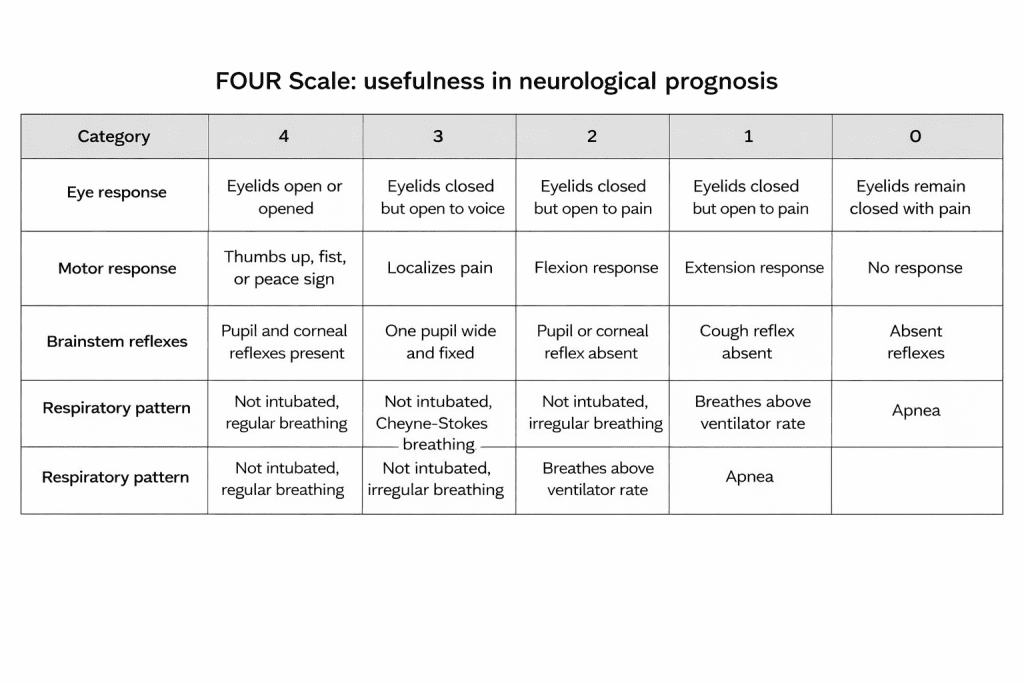
Differences between the FOUR scale and the Glasgow Coma Scale
The GCS does not allow a complete assessment in intubated patients because verbal response cannot be recorded. In contrast, the FOUR scale incorporates brainstem function and respiratory control, providing more relevant information for patients in coma or in intensive care.
Clinical utility of the FOUR scale
-
Neurological prognosis: studies have shown that the FOUR scale better predicts the outcomes of patients in a comatose state, particularly those with severe brain injury.
-
ICU monitoring: it allows for more detailed and accurate tracking of the patient’s daily progression.
-
Application in stroke: in patients with severe stroke, the FOUR scale helps determine the likelihood of neurological recovery or mortality.
-
Assessment in traumatic brain injury: it correlates with neuroimaging findings and functional outcomes.
Advantages of the FOUR scale
-
It does not rely on verbal response, making it valid in intubated patients.
-
It integrates broader parameters of brain function.
-
It is reproducible and reliable across different healthcare professionals.
-
Its score can be correlated with prognostic scales and therapeutic decision-making.
Limitations of the FOUR scale
-
It requires proper training to apply the scale correctly.
-
It may be less well known in certain clinical settings where the GCS still predominates.
-
Its use is not as standardized in international protocols.
Studies and scientific evidence.

The FOUR scale has been validated in multiple settings, demonstrating that:
-
It shows a good correlation with in-hospital mortality.
-
It is associated with long-term functional outcomes.
-
It is useful in clinical research to stratify patients’ neurological status.
Conclusion
The FOUR scale represents a significant advancement in neurological assessment. Its ability to evaluate intubated patients, integrate brainstem reflexes and respiratory patterns, and correlate with clinical prognosis makes it an essential tool in neurology and intensive care. Although it still coexists with the Glasgow Coma Scale, more and more hospital units are incorporating the FOUR scale as a standard of practice.
If you would like more information about NeuroAiD II, please fill out this contact form.
"*" indicates required fields


