



Esophageal strictures are a disorder of the upper gastrointestinal tract characterized by an abnormal narrowing of the esophagus, which impairs the passage of food from the mouth to the stomach. This condition can range from mild discomfort to severe obstruction that compromises nutrition and quality of life. Although multiple causes may be involved, precise diagnostic methods and effective treatments are currently available, allowing the condition to be controlled or even resolved in most cases.
What are esophageal strictures?
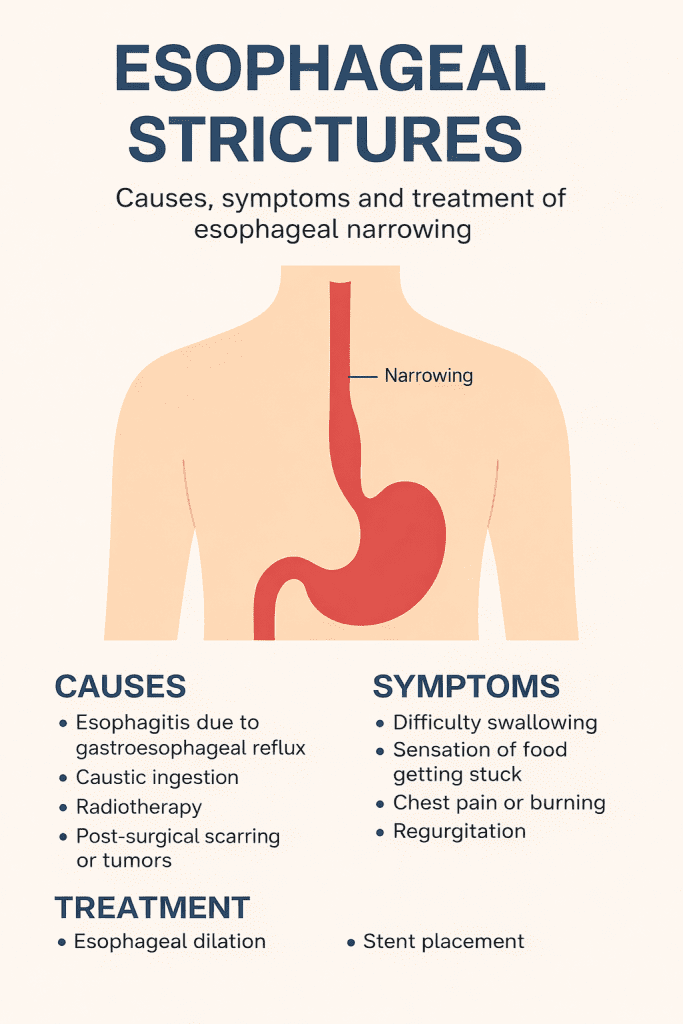
The term stenosis comes from Greek and means narrowing. Therefore, an esophageal stricture is a reduction in the diameter of the esophagus that impairs the passage of the food bolus. This narrowing may be partial or nearly complete and can affect different segments of the esophagus.
The stricture may be of benign or malignant origin and can develop either acutely or progressively, depending on its underlying cause.
Types of esophageal strictures
-
Benign: These are the most common and are usually due to inflammation, scarring, or injuries not related to cancer.
-
Malignant: Caused by esophageal tumors or external compression from adjacent cancers.
Causes of esophageal strictures
Esophageal strictures may have various causes, and it is essential to accurately identify them in order to select the most appropriate treatment. Among the most common are:
1. Esophagitis due to gastroesophageal reflux
Chronic reflux of gastric acid into the esophagus can damage its lining and, over time, lead to scarring that narrows the lumen. This is the most common cause of benign stricture.
2. Caustic ingestion
Accidental or intentional ingestion of corrosive substances such as bleach, ammonia, or acids can cause chemical burns that heal with scarring, leading to severe strictures that are difficult to treat.
3. Radiotherapy
Patients receiving radiotherapy to the thorax or neck may develop strictures as a late adverse effect due to radiation-induced fibrosis.
4. Post-surgical stricture
Certain surgical procedures involving the esophagus or stomach may lead to strictures at anastomotic sites between segments.
5. Strictures due to tumors
Esophageal cancer is a serious cause of stricture. Extrinsic compression from nearby tumors such as lung, thyroid, or lymphomas may also occur.
6. Infections
In immunocompromised patients, infections caused by herpes, cytomegalovirus, or Candida albicans may lead to ulcerations that, upon healing, result in strictures.
7. Congenital strictures
They are rare but may be present from birth as part of esophageal malformations.
8. Medications and foreign bodies
Certain drugs such as bisphosphonates, some antibiotics, or anti-inflammatory agents may cause esophageal injury if not taken properly. Foreign bodies may also damage the mucosa.
Symptoms of esophageal strictures
Symptoms are usually related to difficulty swallowing (dysphagia) and the associated discomfort it causes:
-
Progressive dysphagia: Initially to solids, then to liquids.
-
Sensation of food getting stuck.
-
Chest pain or retrosternal burning.
-
Regurgitation of undigested food.
-
Unintentional weight loss.
-
Sialorrhea (excessive salivation).
-
Cough or pulmonary aspiration in severe cases.
Symptom severity depends on the degree of narrowing and the rate at which it has developed.
Diagnosis
The diagnosis of esophageal strictures is based on clinical history, physical examination, and various complementary tests:
1. Upper gastrointestinal endoscopy
This is the most important test. It allows direct visualization of the esophagus, identification of the site of narrowing, its characteristics (regular or irregular), and biopsy sampling if a malignant cause is suspected.
2. Barium esophagogram
This is a contrast radiographic study that outlines the esophagus. It is useful for assessing the length, location, and severity of the stricture.
3. Computed tomography (CT) or magnetic resonance imaging (MRI)
They are used to evaluate adjacent structures or rule out extrinsic compression.
4. Esophageal manometry
Evaluates the muscular function of the esophagus. It is useful if associated functional causes are suspected.
Treatment
Treatment depends on the underlying cause, the severity of the narrowing, and the patient’s overall condition.
1. Esophageal dilation
This is the most common treatment for benign strictures. It involves inserting a balloon or dilator through endoscopy to widen the narrowed area.
-
Multiple sessions may be required.
-
There is a low risk of perforation.
2. Stent placement
They are mainly used in malignant strictures to maintain esophageal patency and allow oral intake. Some stents are temporary, while others are permanent.
3. Surgery
In severe or refractory cases, surgical resection of the affected segment may be required, with reconstruction using a portion of the stomach or intestine.
4. Medical treatment
-
Proton pump inhibitors (omeprazole, esomeprazole) to control reflux.
-
Oral or injected corticosteroids at the lesion site, in selected cases.
-
Antibiotic therapy or antifungal agents if infection is present.
-
Avoid medications that are harmful to the mucosa.
Complications

If left untreated, esophageal strictures may lead to:
-
Malnutrition and dehydration.
-
Aspiration pneumonia.
-
Spontaneous esophageal perforation.
-
Malignant transformation in poorly controlled chronic cases.
Prognosis
Prognosis varies depending on the underlying cause:
-
Benign strictures: usually respond well to dilation and medical treatment.
-
Malignant strictures: Treatment is palliative, focused on maintaining oral intake and improving quality of life.
-
Caustic strictures: They may require multiple interventions and have a more complex course.
Long-term follow-up is essential to prevent recurrence or complications.
Prevention
Some measures to prevent esophageal strictures include:
-
Early and appropriate treatment of gastroesophageal reflux.
-
Avoid self-medication and properly follow instructions for oral medications.
-
Prevent caustic ingestion, especially in children.
-
Undergo regular follow-up if there is a history of radiotherapy or upper gastrointestinal surgery.
Conclusion
Esophageal strictures are a significant cause of dysphagia and may have a considerable impact on health if not treated in a timely manner. Fortunately, advances in endoscopy, surgery, and medical therapy allow this condition to be managed safely and effectively. In the presence of persistent difficulty swallowing, it is crucial to seek medical evaluation for a comprehensive assessment. Early diagnosis and appropriate treatment can make the difference between a limited life and adequate, healthy oral intake.
If you would like more information about NeuroAiD II, please fill out this contact form.
"*" indicates required fields


