

Anarthria is a severe neurological disorder that affects an individual’s ability to articulate words in an intelligible manner. Unlike other speech disorders such as dysarthria or aphasia, anarthria involves a near-total loss of the ability for oral expression, while language comprehension and the capacity for verbal thinking remain intact.
What is anarthria?
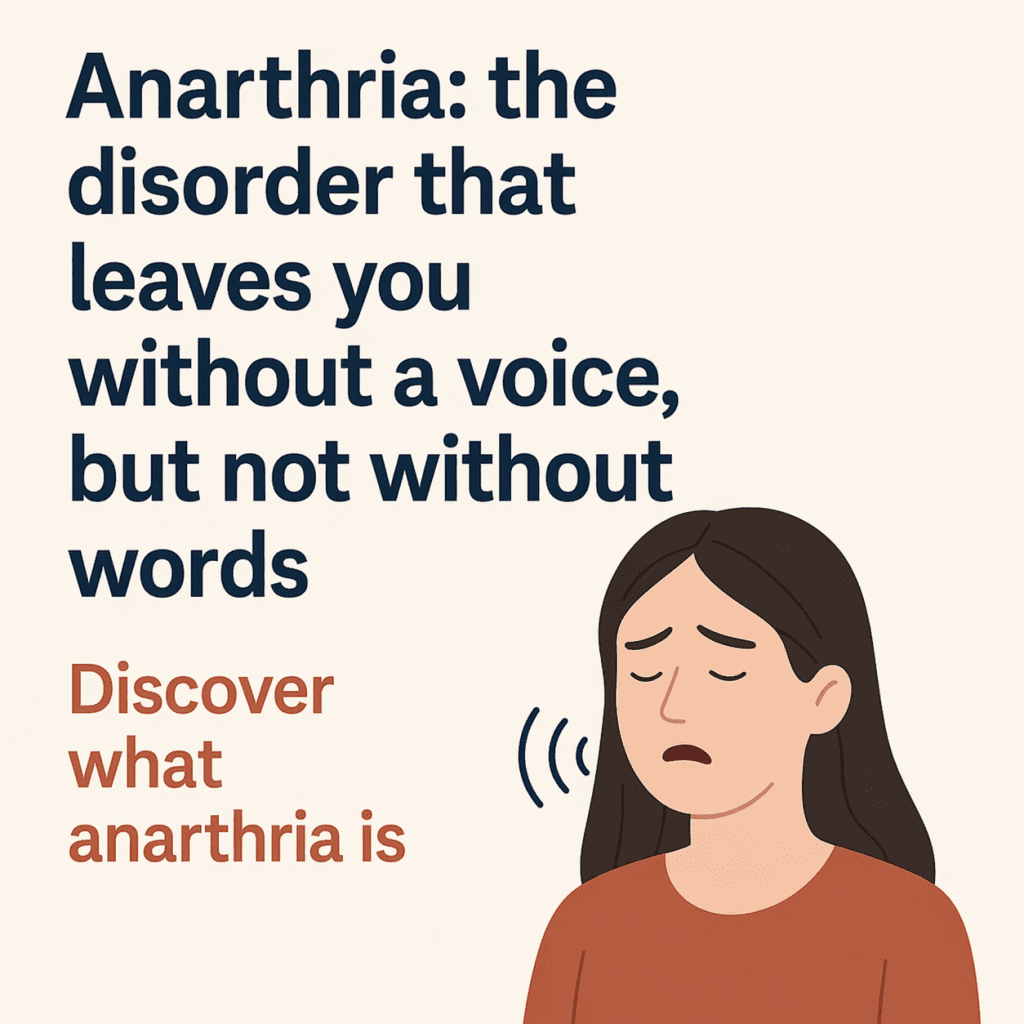
Anarthria is a type of speech disorder that occurs when the muscles responsible for articulation are so severely impaired that the individual is unable to produce intelligible words. Although they may be able to move their mouth, the sounds produced do not form recognizable words. It is not a loss of language itself, as seen in aphasia, but rather an inability to physically execute speech due to damage to the central or peripheral nervous system.
In clinical terms, anarthria is considered the most severe form of dysarthria. While in dysarthria there is still some ability to produce articulated sounds, albeit with difficulty, in anarthria this ability is completely absent.
Causes of anarthria
The causes of anarthria are directly related to damage in the brain structures that control the muscle movements required for speech. The main causes include:
-
Stroke (cerebrovascular accident): a cerebral infarction affecting the motor speech areas can lead to anarthria, especially if it involves both cerebral hemispheres or regions of the brainstem.
-
Severe traumatic brain injury: blows or injuries that affect the motor areas of speech can also cause this disorder.
-
Amyotrophic lateral sclerosis (ALS): in advanced stages, this neurodegenerative disease can lead to anarthria due to progressive involvement of bulbar muscles.
-
Cerebral palsy: in severe cases, there may be a complete lack of muscular control for speech.
-
Neuromuscular disorders: such as muscular dystrophy or myasthenia gravis, which weaken the muscles required for speech production.
-
Brain tumors: if they affect the motor speech areas or subcortical structures involved in articulation, they may result in anarthria.
-
Infectious diseases: such as certain encephalitis or severe neuroinfections.
Diagnosis of anarthria
The diagnosis of anarthria requires a careful clinical evaluation by a neurologist and a speech therapist. Since it can be confused with other language disorders such as Broca’s aphasia or apraxia of speech, it is essential to clearly differentiate each condition in order to properly guide treatment.
Among the tools used for diagnosis, the following stand out:
-
Comprehensive neurological examination: To determine the degree of motor, sensory, and functional impairment.
-
Brain magnetic resonance imaging: To identify lesions in speech motor areas.
-
Electromyography and nerve conduction studies: If a neuromuscular cause is suspected.
-
Speech therapy assessment: Allows analysis of vocal output, muscular control capacity, and response to oral commands.
-
Cognitive and language assessment: To confirm that there is no associated aphasia.
It is important to note that in anarthria, the individual may fully understand spoken language and have intact cognitive abilities, which distinguishes it from other neurological disorders.
Differences between anarthria, aphasia, and apraxia of speech
Although they share some clinical manifestations, anarthria must be clearly differentiated from aphasia and apraxia of speech.
-
Aphasia: It is a language disorder. In some types of aphasia such as Broca’s aphasia, there is difficulty forming sentences, but the person can still pronounce words. In anarthria, the physical production of speech is impaired, while internal language remains preserved.
-
Apraxia of speech: The person knows what they want to say but has difficulty planning the movements required for articulation. In anarthria, the problem is not related to planning, but to muscular execution.
These distinctions are key to applying an appropriate and realistic treatment.
Treatment of anarthria
The treatment of anarthria depends on the underlying cause and the severity of the impairment. Since it is a motor condition rather than a linguistic one, the approach focuses on functional rehabilitation.
Intensive speech therapy
-
Oral motor exercises: Aimed at improving muscular control of the lips, tongue, and jaw.
-
Phonation therapies: Stimulate the production of basic sounds and coordinated breathing.
-
Multisensory stimulation methods: Use of mirrors, vibrations, voice recordings, etc.
-
Biofeedback therapies: Allow the patient to observe and adjust their orofacial movements in real time.
Alternative communication systems
In many cases of anarthria, the main goal of treatment is to restore some form of functional communication, even if it is not spoken.
-
Augmentative and alternative communication systems (AAC): These range from communication boards to electronic devices that convert text into speech.
-
Adapted mobile applications: Some allow the user to write, select symbols, or use eye movements to communicate.
-
Sign language: It may be useful in some cases if the patient retains mobility in the hands.
Emotional and psychological support
Anarthria can be emotionally devastating. Frustration, isolation, and depression are common. Therefore, treatment should include:
-
Professional psychological support.
-
Family therapy.
-
Inclusion of the patient in support groups.
Medical treatment
When anarthria is secondary to a specific condition, treating that condition may improve symptoms. For example:
-
Antiparkinsonian medication.
-
Corticosteroids in inflammatory diseases.
-
Surgery in cases of resectable brain tumors.
However, in many cases the neurological damage is permanent and treatment is focused on compensation and adaptation.
Prognosis of anarthria
The prognosis of anarthria varies depending on the origin and extent of the neurological damage. In mild or transient cases, partial recovery is possible with intensive rehabilitation. In more severe situations, the goal is to achieve an effective alternative form of communication.
Some factors that influence prognosis:
-
Patient age.
-
Speed of treatment initiation.
-
Family and social support.
-
Motivation and adherence to rehabilitation.
-
Associated comorbidities such as dementia or depression.
It is essential to understand that the treatment of anarthria not only aims to restore speech, but also to preserve the patient’s dignity and right to communicate.
Conclusion
Anarthria is one of the most severe speech disorders, but it does not imply a loss of thought or internal language. Despite the severity of its presentation, there are multiple therapeutic strategies to improve the quality of life of those affected.
Early diagnosis, personalized treatment, and the use of assistive technology are key for individuals with anarthria to continue communicating, participating in society, and maintaining meaningful relationships. Emotional support and the human environment surrounding the patient are just as important as any medical or speech therapy.
If you would like more information about NeuroAiD II, please fill out this contact form.
"*" indicates required fields


