

Speech disorders can profoundly affect a person’s quality of life, especially when they are associated with neurological conditions. Among the most significant are dysarthria and anarthria, two disorders that, although related, present important differences in both their origin and clinical manifestation.
What is dysarthria?
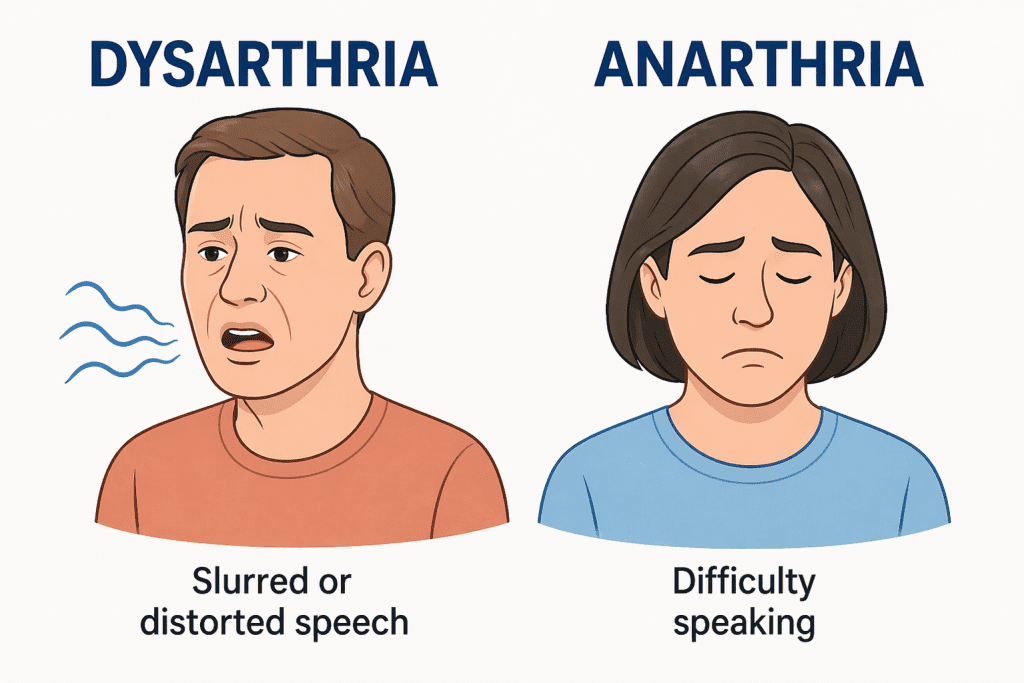
Dysarthria is a neurological speech disorder caused by weakness, paralysis, or lack of coordination of the muscles used for speaking. These include the muscles of the tongue, lips, vocal cords, and diaphragm. Unlike language disorders such as aphasia, dysarthria does not affect comprehension or the formation of ideas, but rather the motor execution of speech.
People with dysarthria may present slow, slurred, monotonous, or nasal speech. They may also experience difficulty controlling the volume of their voice or articulating sounds clearly. Dysarthria can be mild or severe, depending on the extent of the underlying neurological damage.
What is anarthria?
Anarthria represents the most severe form of dysarthria. In this case, motor control is so impaired that the patient is unable to articulate any words intelligibly. Anarthria does not imply a loss of cognitive ability or inner language, but rather a complete inability to express oneself orally.
A person with anarthria can fully understand what is being said and know what they want to communicate, but they are unable to do so verbally. This type of impairment requires intensive multidisciplinary intervention to find alternative forms of communication.
Differences between dysarthria and anarthria
Although closely related, dysarthria and anarthria are not synonymous. While dysarthria can range in severity from mild speech disturbances to significant articulation difficulties, anarthria represents the extreme end of this spectrum where speech is completely absent.
An essential difference is that individuals with dysarthria are still able to produce vocal sounds, although these may be distorted or unclear. In contrast, patients with anarthria are unable to generate functional speech. This distinction has critical implications for diagnosis, treatment, and rehabilitation.
Common causes of dysarthria and anarthria
The causes of dysarthria and anarthria are associated with lesions or dysfunctions of the central or peripheral nervous system. The most common include:
-
Stroke: This is the most common cause. Depending on the affected area, the patient may present with mild dysarthria or progress to anarthria.
-
Traumatic brain injuries: Severe damage to motor regions of the brain can result in complete loss of speech.
-
Neurodegenerative diseases: Such as amyotrophic lateral sclerosis (ALS), Parkinson’s disease, or multiple sclerosis.
-
Cerebral palsy: In children, it can lead to generalized motor impairments, including dysarthria.
-
Brain tumors: If they involve motor speech areas.
-
Infectious or inflammatory diseases: Such as encephalitis or disseminated sclerosis.
Diagnosis of dysarthria and anarthria
Accurate diagnosis of dysarthria and anarthria requires a comprehensive evaluation by a multidisciplinary team, including neurologists, speech-language pathologists, and in some cases, psychiatrists or clinical psychologists.
Various diagnostic tools are used, including:
-
Neurological examinations to identify the underlying cause of the disorder.
-
Speech assessments that analyze articulation, rate, volume, and prosody.
-
Imaging studies such as magnetic resonance imaging or computed tomography scans.
-
Videofluoroscopy to assess the coordination of the muscles involved in speech.
An early and accurate diagnosis allows for the implementation of a more effective treatment plan tailored to the severity of impairment.
Treatment of dysarthria and anarthria
The treatment of dysarthria and anarthria is based on functional rehabilitation and compensation for lost abilities. Although there is no definitive cure, intensive speech therapy can significantly improve the patient’s quality of life.
Speech-language therapy rehabilitation
-
Articulation exercises: Improve the accuracy of speech sounds.
-
Breathing therapies: To control voice intensity and duration.
-
Intonation and rhythm training: Help make speech more intelligible.
-
Auditory and visual feedback: The use of recordings can help the patient self-correct.
In cases of anarthria, therapy focuses on achieving some form of functional vocalization or implementing augmentative and alternative communication (AAC) systems.
Pharmacological treatment
Although there are no specific medications for dysarthria or anarthria, some underlying conditions may require medical treatment. For example:
-
Antispastic agents in patients with cerebral palsy.
-
Antiparkinsonian medications in cases of dysarthria associated with Parkinson’s disease.
-
Antidepressants if the speech impairment leads to affective symptoms.
Assistive technology
-
Tablets with communication software: Useful in patients with severe anarthria.
-
Mobile applications that convert text to speech.
-
Eye-tracking systems for individuals who are unable to use their hands.
Technology has expanded interaction possibilities for individuals with severe dysarthria and anarthria, even enabling them to maintain professional or academic activities remotely.
Prognosis and progression

The prognosis of dysarthria and anarthria largely depends on the underlying cause, the patient’s age, the time elapsed since the injury, and the intensity of rehabilitation.
-
In mild cases, dysarthria may resolve completely with treatment.
-
In severe cases, it may become chronic, but can improve with consistent practice.
-
Anarthria typically has a guarded prognosis, but alternative communication methods can compensate for the loss.
Rehabilitation should be initiated as early as possible, ideally within the first weeks after the onset of the disorder.
Both dysarthria and anarthria can lead to isolation, frustration, low self-esteem, and depression. The inability to communicate as before represents a profound emotional challenge. Access to psychological support and strong family or community support networks is essential.
Emotional support should be an integral part of the treatment approach. Group therapy, nonverbal expression workshops, and patient support groups can play a key role in this process.
Conclusion
Dysarthria and anarthria are speech disorders that significantly impact the lives of those affected. Understanding their differences, causes, and therapeutic options not only enables more effective intervention strategies but also fosters greater social empathy toward affected individuals.
Although full recovery is not always possible, multiple rehabilitation and support strategies can significantly improve quality of life. The commitment of the medical team, active patient participation, and environmental support are essential pillars to face the rehabilitation process with dignity and hope.
If you would like more information about NeuroAiD II, please fill out this contact form.
"*" indicates required fields


