


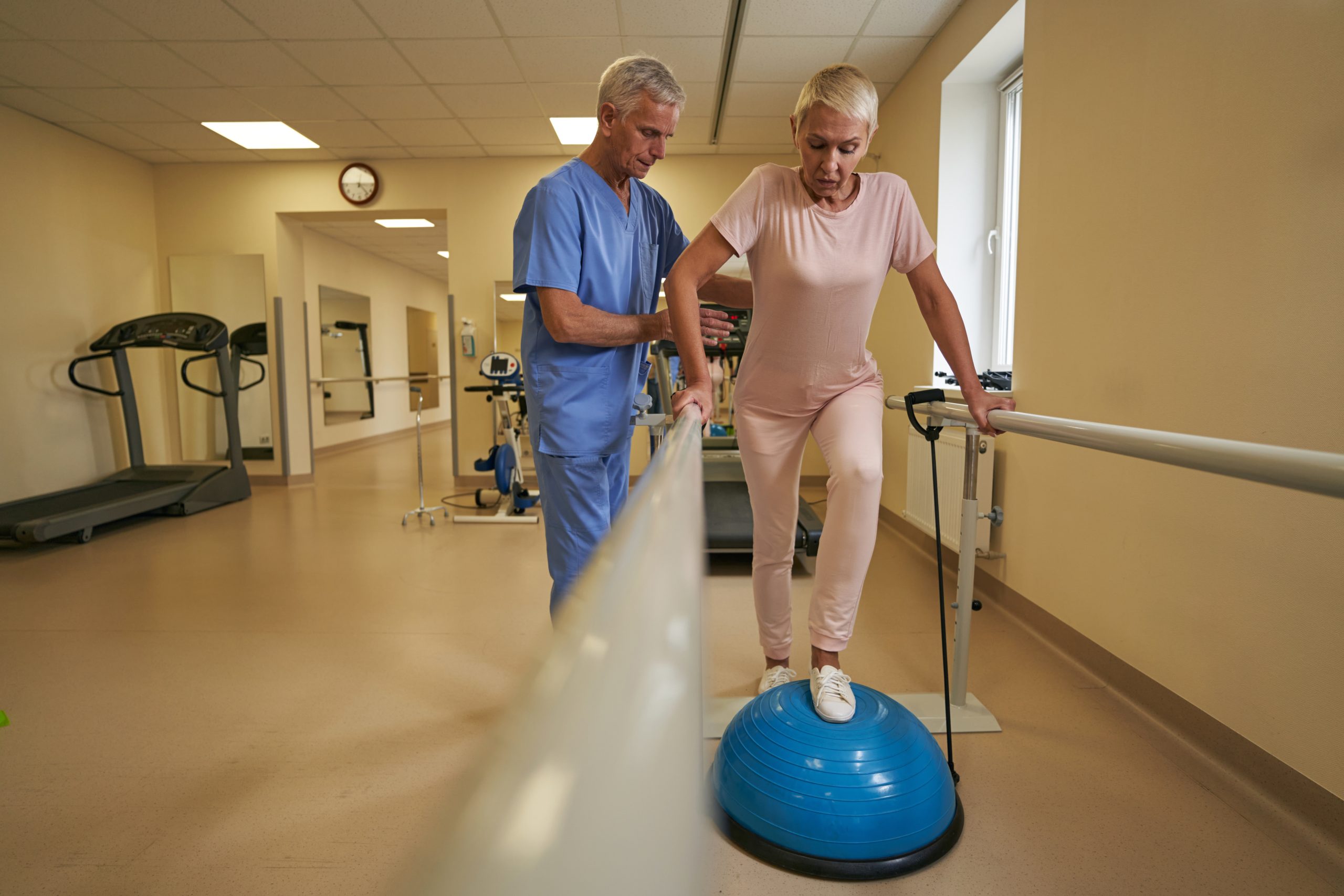

The Berg Balance Scale (BBS) is a widely used assessment tool for evaluating an individual’s balance. Its primary purpose is to measure the ability to maintain stability during different everyday activities, helping to identify the risk of falls and monitor changes in mobility over time.
This scale is frequently used in individuals who have experienced a stroke, as well as in patients with neurological conditions, balance disorders, or mobility limitations. Due to its simplicity and clinical utility, it has become one of the most widely used assessment tools among physiotherapists and other rehabilitation professionals.
What is the Berg Balance Scale?
The Berg Balance Scale is a functional assessment designed to evaluate balance by observing an individual performing a series of tasks. Each activity assesses aspects such as stability, postural control, and the ability to change positions safely.
The results provide an overall indication of the patient’s balance and help monitor progress throughout the rehabilitation process.
Although the assessment is particularly used in older adults and patients with neurological impairments, it can also be applied in other situations where there is a risk of balance loss.
What does the Berg Balance Scale assess?

The assessment evaluates balance both in static positions and during movement. To do this, the healthcare professional asks the patient to perform a series of common activities of daily living.
The tasks assessed include:
- Sitting without support.
- Standing up from a chair.
- Standing without assistance.
- Sitting down again in a controlled manner.
- Transferring between two surfaces.
- Standing with the eyes closed.
- Maintaining balance with the feet together.
- Reaching forward without losing balance.
- Picking up an object from the floor.
- Turning the trunk to look over both shoulders.
- Turning 360 degrees.
- Alternately placing each foot on a step.
- Standing with one foot in front of the other.
- Standing on one leg.
These activities represent movements that many people perform in everyday life and help assess how the balance system responds in different situations.
How is it scored?
The Berg Balance Scale consists of 14 tasks, each scored from 0 to 4 points.
- 0 points: the patient is unable to perform the activity or requires significant assistance.
- 4 points: the activity is completed independently and safely.
The maximum possible score is 56 points, indicating a better level of balance.
How are the results interpreted?
The score obtained helps estimate the degree of balance impairment and the risk of falls.
In general:
- 41 to 56 points: relatively preserved balance and a lower risk of falls.
- 21 to 40 points: moderate balance impairment.
- 0 to 20 points: significant balance impairment, with a higher risk of falls and mobility limitations.
The results should always be interpreted alongside a comprehensive clinical assessment, as other factors such as muscle strength, vision, and cognitive function can also affect balance.
Why is it used after a stroke?
Following a stroke, balance impairments are common due to muscle weakness, loss of coordination, spasticity, or changes in sensation.
The Berg Balance Scale helps determine how these impairments affect the patient’s stability and provides a reference for assessing recovery over time.
By repeating the assessment at different stages, healthcare professionals can determine whether balance is improving and adjust rehabilitation goals according to the patient’s progress.
Advantages of the Berg Balance Scale
One of the main advantages of this assessment tool is that it is easy to administer and does not require complex equipment.
In addition, it provides a structured assessment of balance that can be repeated periodically to compare results and document changes throughout the recovery process.
Its use also facilitates communication among the different healthcare professionals involved in the patient’s care, as it provides an objective measure of balance function.
Does it have limitations?
Like any clinical assessment, the Berg Balance Scale has some limitations.
In individuals with nearly normal balance, it may be less sensitive in detecting subtle impairments. On the other hand, some patients with severe limitations may be unable to complete all the tasks, reducing the amount of information obtained.
In addition, the scale assesses specific situations within a controlled environment and may not always reflect all the difficulties an individual experiences in daily life.
For this reason, it is often used in combination with other functional assessments and the healthcare professional’s clinical observations.
Which healthcare professionals use this scale?

The Berg Balance Scale is routinely used by a wide range of healthcare professionals involved in rehabilitation.
Healthcare professionals who commonly use it include:
- Physiotherapists.
- Rehabilitation physicians.
- Occupational therapists.
- Neurologists.
- Specialized neurological rehabilitation teams.
Its use provides an initial assessment and enables objective monitoring of the patient’s functional progress over time.
Conclusion
The Berg Balance Scale (BBS) is a clinical assessment tool designed to evaluate balance through 14 functional tasks that simulate everyday movements. Its score helps estimate the risk of falls and assess an individual’s level of stability, particularly in patients who have experienced a stroke or other neurological conditions.
Due to its ease of administration and usefulness in monitoring changes in balance over time, it remains one of the most widely used assessment tools in rehabilitation.
If you would like more information about NeuroAiD II, please complete this contact form
"*" indicates required fields


