



Aphagia is a severe swallowing disorder in which the individual completely loses the ability to swallow food, liquids, or even their own saliva. This clinical condition is more serious than dysphagia, as it involves total inability, with significant nutritional, respiratory, and social consequences. Understanding the causes of aphagia is essential to establish an accurate diagnosis and implement appropriate treatment.
What is aphagia?
Aphagia is defined as the complete inability to initiate or complete the act of swallowing. Unlike dysphagia, which allows some degree of swallowing albeit with difficulty, aphagia involves a total disruption of the bolus transport process from the oral cavity to the stomach.
This disorder may be temporary or permanent, depending on its underlying cause, and typically requires urgent intervention due to the risk of malnutrition, dehydration, and pulmonary aspiration.
Main causes of aphagia
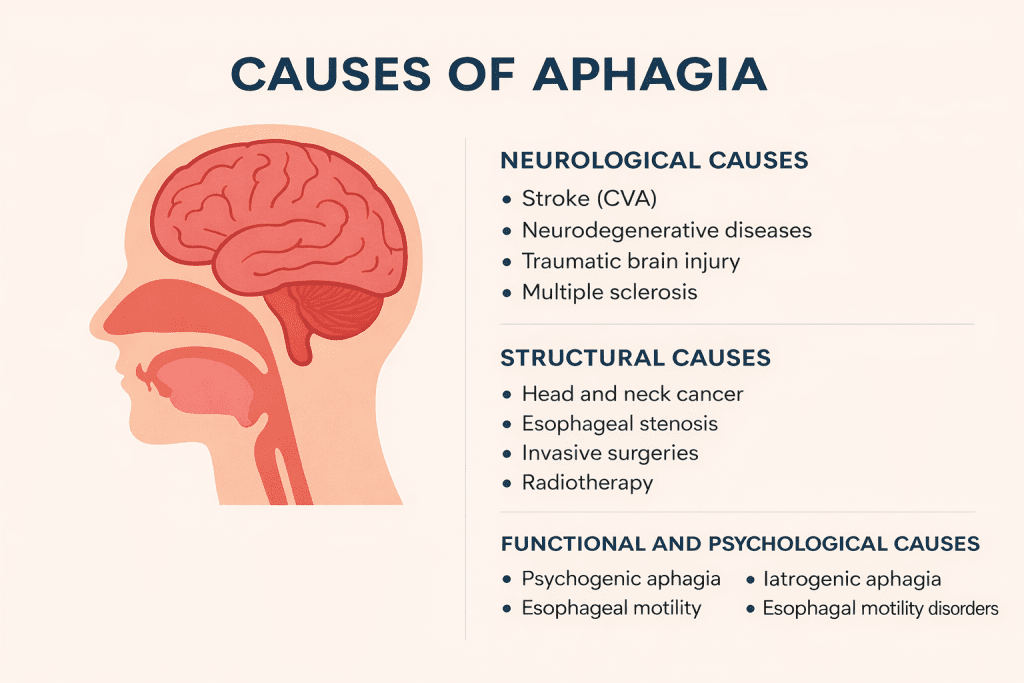
The causes of aphagia can be classified into three main groups: neurological, structural, and functional or psychological. Each group has its own clinical characteristics and underlying mechanisms.
1. Neurological causes of aphagia
Neurological causes are the most frequent in cases of aphagia. In these situations, the loss of swallowing ability occurs due to damage to the brain, cranial nerves, or the motor pathways involved in swallowing.
a. Stroke
Stroke is one of the main causes of aphagia. When it affects cortical areas or the brainstem regions responsible for swallowing coordination, it can lead to complete aphagia. Involvement of the swallowing center in the medulla oblongata is particularly severe.
b. Neurodegenerative diseases
Conditions such as amyotrophic lateral sclerosis (ALS), advanced Parkinson’s disease, or Huntington’s disease can cause progressive aphagia due to degeneration of motor neurons.
c. Traumatic brain injuries
Severe trauma affecting the brainstem or motor cortical areas may induce aphagia, either temporarily or permanently.
d. Multiple sclerosis
In some patients, demyelinating lesions affect the neurological centers responsible for swallowing, which may trigger aphagia in advanced stages.
2. Structural causes of aphagia
These causes are related to anatomical alterations that physically obstruct or prevent the passage of the food bolus.
a. Head and neck cancer
Tumors in the tongue, pharynx, larynx, or upper esophagus may cause aphagia by obstructing the passage of food or disrupting the mechanics of swallowing.
b. Invasive surgeries
Surgical resections due to cancer, such as glossectomies or total laryngectomies, may result in irreversible functional loss of swallowing.
c. Esophageal stenosis
Although they are typically associated with dysphagia, in more severe cases stenosis may progress to aphagia if the esophageal lumen becomes completely obstructed.
d. Radiotherapy
The side effects of radiotherapy in the oropharyngeal region may cause severe fibrosis, which compromises the mobility of the swallowing muscles and can lead to aphagia.
3. Functional and psychological causes of aphagia
In some cases, aphagia is not due to evident structural or neurological damage, but rather to functional, behavioral, or psychogenic factors.
a. Psychogenic or conversion aphagia
This is a rare form of aphagia in which the patient presents a genuine inability to swallow, without an identifiable organic cause. It is associated with conversion disorders or severe anxiety.
b. Iatrogenic aphagia
Certain pharmacological treatments or medical interventions may disrupt the swallowing reflex, especially in patients with pre-existing conditions.
c. Advanced esophageal motility disorders
Although they are more commonly associated with dysphagia, certain disorders such as achalasia may lead to such severe functional obstruction that the patient ultimately develops secondary aphagia.
Pathophysiological mechanisms
To better understand the causes of aphagia, it is important to recognize the mechanisms altered in this disorder. Swallowing depends on a precise sequence of events:
-
Preparation and transport of the bolus within the oral cavity
-
Activation of the swallowing reflex in the oropharynx
-
Pharyngeal contraction to propel the bolus
-
¿Quieres que continúe con el siguiente bloque de texto?
When one or more of these steps fails completely, due to neuronal damage, physical obstruction, or functional impairment, aphagia occurs.
Clinical evaluation of aphagia
The diagnosis of aphagia requires specialized medical evaluation. The main steps include:
-
Detailed medical history: Includes neurological, oncological, and psychological background.
-
Orofacial examination: Assesses the mobility of the tongue, lips, soft palate, and gag reflex.
-
Videofluoroscopic swallowing study: A radiological assessment that shows in real time how the bolus behaves during swallowing.
-
Fiberoptic endoscopic evaluation of swallowing (FEES): Allows direct visualization of the pharynx and larynx during swallowing attempts.
-
Neurological and psychological assessments: Indicated when a functional or psychiatric origin is suspected.
Clinical consequences of aphagia
The causes of aphagia not only determine the treatment, but also the complications that may arise:
-
Severe malnutrition and dehydration
-
Bronchoaspiration and recurrent pneumonia
-
Dependence on enteral feeding (via nasogastric tube or gastrostomy)
-
Social isolation and emotional deterioration
-
Loss of quality of life
Therapeutic approach
Treatment depends directly on the underlying causes of aphagia:
-
Intensive speech and language therapy: In post-stroke or traumatic aphagia.
-
Enteral feeding: When swallowing cannot be restored in the short term.
-
Surgical or oncological treatment: In cases of obstructive tumors.
-
Psychological intervention: In aphagia of conversion origin.
-
Targeted pharmacotherapy: In neuromuscular or inflammatory disorders.
Conclusion
The causes of aphagia are diverse, complex, and often multifactorial. Accurate identification is essential to establish prognosis and design an effective treatment. Whether of neurological, structural, or functional origin, aphagia constitutes a clinical emergency that requires a multidisciplinary approach.
Recognizing the causes of aphagia not only enables timely intervention, but also helps prevent serious complications and improve the quality of life of patients affected by this debilitating condition.
If you would like more information about NeuroAiD II, please fill out this contact form.
"*" indicates required fields


