


In the field of neurology, terms such as stroke and TIA are frequently used, but they are not always clearly understood by the general public. Understanding the difference between a stroke and a TIA is essential to act quickly and make decisions that can save lives or prevent irreversible neurological damage.
What is a stroke?
A stroke, also known as a cerebrovascular accident (CVA), is a sudden disruption of blood flow in the brain. It may be caused by:
-
An arterial blockage (ischemic stroke): accounts for approximately 85% of cases. Blood flow is interrupted by a clot or narrowing of a cerebral artery.
-
A rupture of a blood vessel (hemorrhagic stroke): less common but more severe, it occurs when a vessel ruptures and causes bleeding in the brain.
Both types of stroke cause a sudden neurological deficit such as paralysis, difficulty speaking, loss of vision, or impaired balance. The key is to act quickly, as every minute that passes may result in the loss of millions of neurons.
What is a transient ischemic attack (TIA)?
A TIA, or transient ischemic attack, is an event similar to a stroke but much shorter in duration and without causing permanent brain damage. It occurs due to a temporary interruption of blood flow to the brain, usually caused by a small clot that dissolves on its own.
Although the symptoms are identical to those of a stroke (weakness, confusion, difficulty speaking, loss of balance), they resolve completely within less than 24 hours, typically within less than one hour.
What is the difference between a stroke and a transient ischemic attack (TIA)?
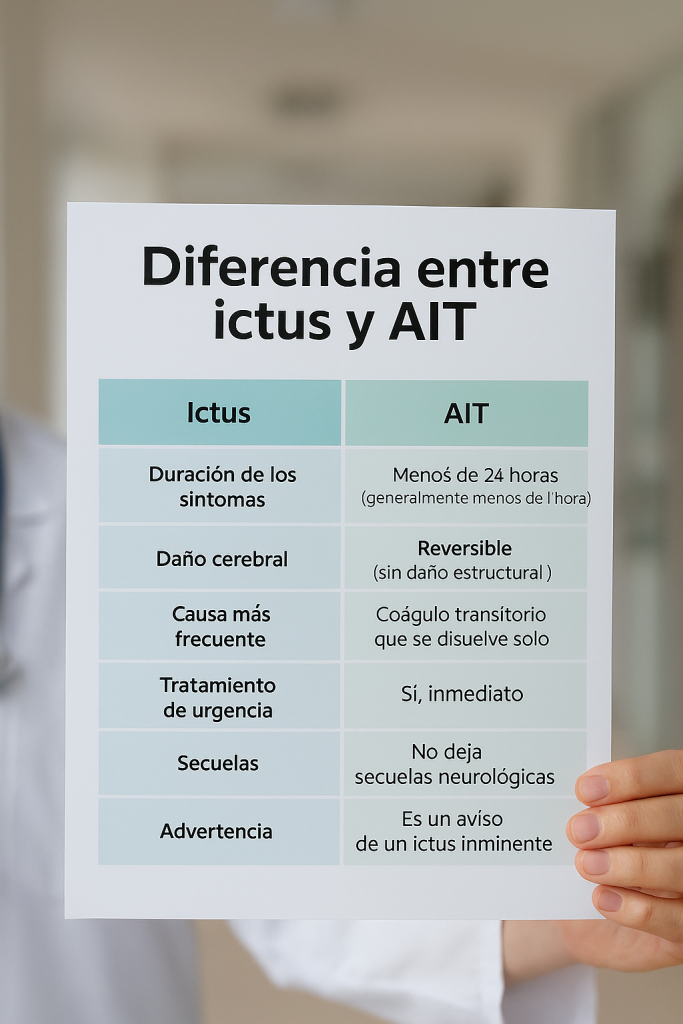
The main difference between a stroke and a transient ischemic attack (TIA) lies in their duration and the extent of damage they cause.
| Characteristic | Stroke | TIA |
|---|---|---|
| Duration of symptoms | More than 24 hours | Less than 24 hours (typically less than 1 hour) |
| Brain damage | Permanent | Reversible (no structural damage) |
| Most common cause | Persistent clot or hemorrhage | Transient clot that resolves on its own |
| Emergency treatment | Yes, immediate | Yes, even if symptoms resolve |
| Sequelae | May result in disabilities | Does not cause neurological sequelae |
| Warning | It is the event itself | It is a warning sign of an imminent stroke |
Therefore, a TIA acts as a warning sign that a severe stroke may occur if urgent preventive measures are not taken.
How do both present clinically?
The symptoms are practically the same, which is why they are often confused. The only way to distinguish them is by the duration and subsequent medical evaluation. Some of the common symptoms include:
-
Weakness or paralysis on one side of the body.
-
Sudden loss of vision.
-
Difficulty speaking or understanding.
-
Loss of balance or coordination.
-
Severe headache in hemorrhagic stroke.
Since the initial symptoms are identical, the medical recommendation is to treat every episode as a stroke until proven otherwise.
Diagnosis: how to differentiate clinically
Once the patient arrives at the hospital, healthcare professionals perform a series of tests such as:
-
Computed tomography (CT) scan or magnetic resonance imaging (MRI) to detect brain damage or hemorrhage.
-
Blood tests to assess coagulation factors, cholesterol, glucose, and other parameters.
-
Electrocardiogram (ECG) and Doppler ultrasound to identify potential sources of clots in the heart or arteries.
If no evidence of cerebral infarction is found and symptoms have resolved within less than 24 hours, the diagnosis is TIA. In contrast, if there is structural damage or symptoms persist, a stroke is confirmed.
Treatment: similar approach but different objectives
Although one is transient and the other permanent, both require immediate medical intervention. The difference between a stroke and a TIA does not reduce the urgency:
-
In ischemic stroke, intravenous thrombolysis (tPA) may be administered within the first 4.5 hours, or a thrombectomy may be performed.
-
In hemorrhagic stroke, treatment may include surgery and intracranial pressure management.
-
In TIA, the objective is to prevent a future stroke through medication adjustments, including antiplatelets, anticoagulants, and control of hypertension, diabetes, and cholesterol.
In addition, neurological rehabilitation should be initiated as early as possible in both cases.
TIA: an opportunity for prevention

One of the reasons why understanding the difference between a stroke and a TIA is so important is that the latter represents a window of opportunity. It is estimated that:
-
1 in 3 people who experience a TIA will have a full stroke in the following days or weeks.
-
10% may experience it within the first 48 hours.
-
20% within the first three months if no action is taken.
Therefore, recognizing a TIA in time can literally save lives and prevent permanent disabilities.
Rehabilitation and follow-up
Once the acute phase has been overcome, both stroke and TIA patients should undergo clinical follow-up. In the case of stroke, rehabilitation includes:
-
Physiotherapy to restore mobility.
-
Occupational therapy to improve independence.
-
Speech therapy if there are speech or swallowing disorders.
-
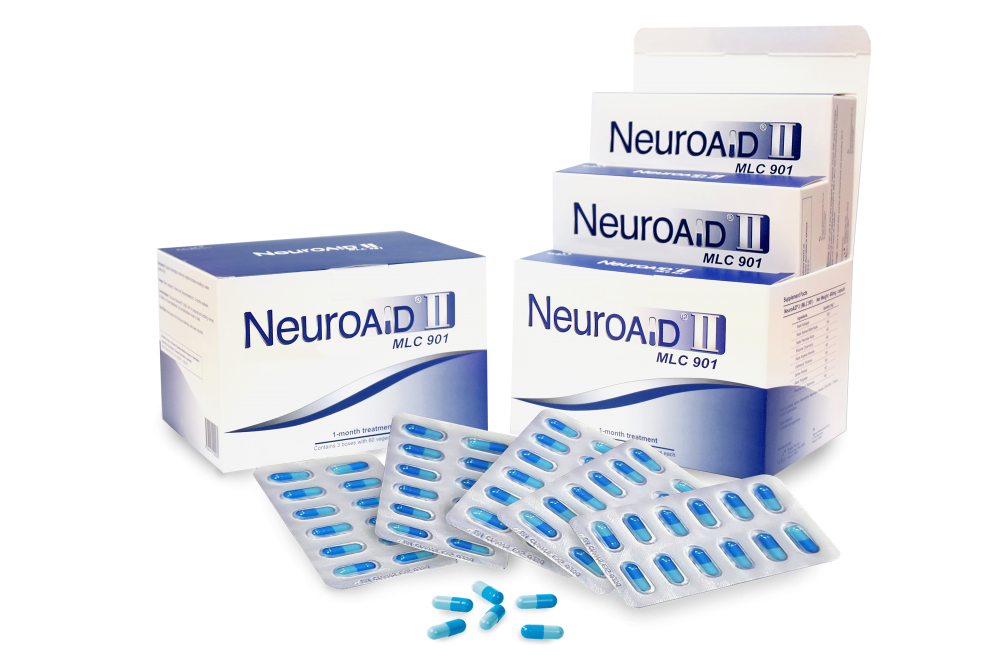
Pharmacological treatment and, in some cases, neurorestorative supplements such as NeuroAiD II, aimed at supporting brain neuroplasticity.
In patients with TIA, the focus is primarily on secondary prevention, including strict monitoring, smoking cessation, a healthy diet, regular exercise, and adherence to medication.
How to act in case of symptoms?
Since the difference between a stroke and a TIA cannot be determined at the time symptoms occur, the correct approach is to seek immediate medical attention. It is recommended to remember the “STROKE CODE” rule:
-
Facial drooping (asymmetry when smiling).
-
Arm weakness (inability to raise it properly).
-
Speech impairment (slurred or confused speech, or difficulty speaking).
-
Time (call emergency services immediately).
Conclusion
Understanding the difference between a stroke and a TIA is not just a matter of medical terminology, but of awareness and prevention. Stroke leaves profound impacts on the lives of those affected, while a TIA is a final warning that offers the opportunity to prevent those consequences if action is taken in time.
Do not wait for symptoms to worsen or assume that everything is fine if they disappear. Any sudden neurological change must be evaluated immediately by healthcare professionals. Time is critical. Life and quality of life are at stake.
If you would like more information about NeuroAiD II, please fill out this contact form.
"*" indicates required fields


