



A thalamic infarction is a type of ischemic stroke that occurs when blood flow to the thalamus is interrupted. The thalamus is a structure located in the center of the brain that plays an essential role in processing sensory information, motor control, attention, and level of consciousness.
Although thalamic infarctions account for a relatively small proportion of all strokes, they can cause a wide range of symptoms because the thalamus acts as a major relay center connecting different regions of the brain. Depending on the vascular territory affected, clinical manifestations may range from sensory loss to cognitive impairment, movement disorders, or chronic pain.
What is the function of the thalamus?

The thalamus consists of numerous nuclei that receive and transmit information between different areas of the nervous system. Its function extends far beyond that of a simple “relay center,” as it also plays an active role in the integration and modulation of multiple brain processes.
Its main functions include:
- Processing sensations such as touch, temperature, pain, and vibration.
- Contributing to motor control.
- Participating in the regulation of attention and alertness.
- Integrating visual and auditory information.
- Contributing to processes related to memory, learning, and certain cognitive functions.
Therefore, a lesion in the thalamus can simultaneously affect several neurological functions.
What causes a thalamic infarction?
Most thalamic infarctions are caused by occlusion of small perforating arteries arising primarily from the posterior cerebral artery and, in some cases, from the posterior communicating artery.
The most common risk factors include:
- Hypertension.
- Diabetes mellitus.
- High cholesterol.
- Smoking.
- Atrial fibrillation.
- Small vessel disease.
- Advanced age.
Less commonly, the infarction may be associated with an anatomical variant known as the artery of Percheron, whose occlusion can cause a bilateral thalamic infarction.
Symptoms of a thalamic infarction
Symptoms depend on the thalamic nucleus affected and the size of the infarction. In some patients, the clinical manifestations may be mild, while in others they can be disabling.
The most common symptoms include:
Sensory disturbances
Sensory loss is one of the most characteristic findings. It may affect touch, temperature, pain, or the perception of limb position.
It typically occurs on the side of the body opposite to the brain lesion.
Central post-stroke pain
Weeks or even months after the infarction, some patients develop severe pain known as central post-stroke pain or thalamic pain syndrome.
This pain may present as:
- A burning sensation.
- Electric shock-like sensations.
- Stabbing pain.
- Hypersensitivity to touch.
- Pain triggered by mild stimuli.
This condition is caused by damage to the sensory pathways of the central nervous system.
Motor impairments
Although the thalamus is not a primary motor structure, some patients may experience:
- Muscle weakness.
- Clumsiness of movement.
- Coordination difficulties.
- Balance disturbances.
- Difficulty walking.
These manifestations typically occur when adjacent structures are also affected.
Cognitive and behavioral changes
Depending on the vascular territory affected, patients may experience:
- Memory problems.
- Attention difficulties.
- Slower information processing.
- Emotional changes.
- Confusion.
- Drowsiness.
Bilateral thalamic infarctions may cause more pronounced disturbances in the level of consciousness.
Visual disturbances
Some patients may experience abnormalities in eye movements, double vision, or difficulty directing their gaze appropriately, particularly when the lesion extends into adjacent regions of the brainstem.
Types of thalamic infarction
The thalamus receives its blood supply from several different arteries, resulting in different patterns of thalamic infarction.
The main types include:
- Anterior thalamic infarction.
- Paramedian thalamic infarction.
- Inferolateral thalamic infarction.
- Posterior thalamic infarction.
Each type can cause different symptoms depending on the thalamic nuclei affected.
How is it diagnosed?
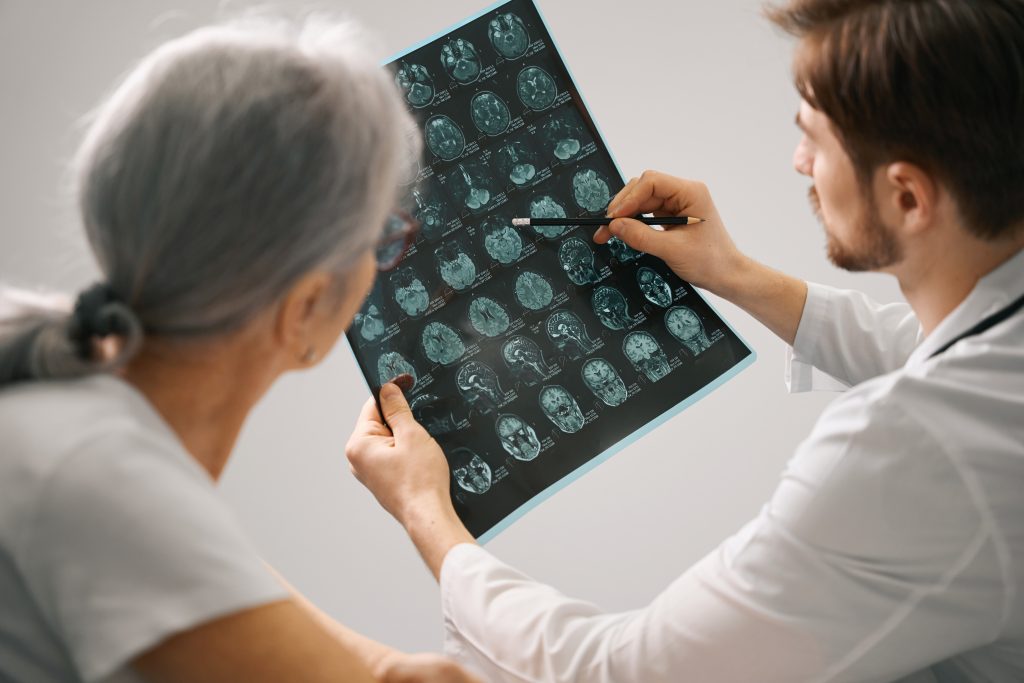
Diagnosis combines neurological examination with neuroimaging techniques.
The most commonly used tests include:
- Brain magnetic resonance imaging (MRI).
- Computed tomography (CT).
- CT angiography or magnetic resonance angiography.
- Cardiac investigations when an embolic source is suspected.
- Blood tests to identify vascular risk factors.
Magnetic resonance imaging is generally the most sensitive technique for detecting small thalamic infarctions.
Treatment
Treatment depends on how soon the stroke is diagnosed and on its underlying cause.
During the acute phase, therapies indicated for the treatment of ischemic stroke may be used when the patient meets the established eligibility criteria.
Subsequent management includes:
- Blood pressure control.
- Management of diabetes and high cholesterol.
- Prevention of recurrent strokes.
- Physical rehabilitation.
- Occupational therapy.
- Neuropsychological rehabilitation when cognitive impairments are present.
- Specialized management of central post-stroke pain if thalamic pain syndrome develops.
Management often requires the involvement of a multidisciplinary team.
Prognosis
The clinical course depends on the location and size of the infarction, as well as how quickly treatment is initiated.
Many patients experience significant recovery during the first few months due to brain neuroplasticity and rehabilitation programs. However, some may develop persistent neurological deficits, particularly sensory disturbances or chronic central post-stroke pain.
When the infarction affects both thalami, the prognosis is generally more complex due to the potential impairment of consciousness and various cognitive functions.
The importance of thalamic infarction
Although the thalamus is a relatively small structure, it plays an essential role in brain function. An infarction in this region can affect sensation, movement, pain perception, and various cognitive functions, even when the lesion is small.
Recognizing the symptoms of a thalamic infarction can facilitate earlier diagnosis and prompt initiation of treatment and rehabilitation, which are essential for promoting functional recovery and reducing the risk of long-term complications.
If you would like more information about NeuroAiD II, please complete this contact form.
"*" indicates required fields


